
Identify a Seward County Owner
No single screen in Seward County answers every version of the ownership question. The county spreads the trail across its GIS, tax, appraiser, and Register of Deeds systems. Use the map to identify the tract. Use the tax or CAMA layer to pull an administrative owner name. Then turn to the Register of Deeds. The deed records there verify the latest recorded conveyance. Each source answers a different piece of "who owns this property."
- Search the address in Seward County's tax module or enter the public CAMA gateway. Record the parcel ID, owner label, legal description, and update date that are actually shown.
- Match the legal description to the parcel in the county GIS. A mailing ZIP or permit address alone does not establish city limits or ownership.
- Search the latest conveyance through the Register of Deeds. Compare grantee, recording date, instrument or book reference, and land description.
- If the grantee is a business, check the Kansas Business Entity Search for the entity record. A resident agent is a contact role, not proof that the agent owns the land.
For name searches, the county tax system recommends starting with only a last name. That keeps the result set broad. If the name is common, narrow it with the parcel number, subdivision, or legal description. The full search mechanics are covered in the property search, while the present roll field is examined in the current owner record.
Use Seward Current Owner Search
The tax portal offers unusually clear name choices: Current Owner, Taxpayer, or Both. Those labels are not synonyms. "Current Owner" is the closest administrative answer to who owns a Seward County property. "Taxpayer" points to the party attached to tax handling. "Both" widens the net when the two roles differ.
The search screen also includes CAMA components. It covers parcel, tax unit, street number, street name, subdivision, section, township, range, lease name, and Quick Ref. Current-tax and taxes-due limits are available too. Street Direction and ZIP Code labels appear without working input controls. So no search method should promise those filters. Open the live tax owner search to try the options directly.
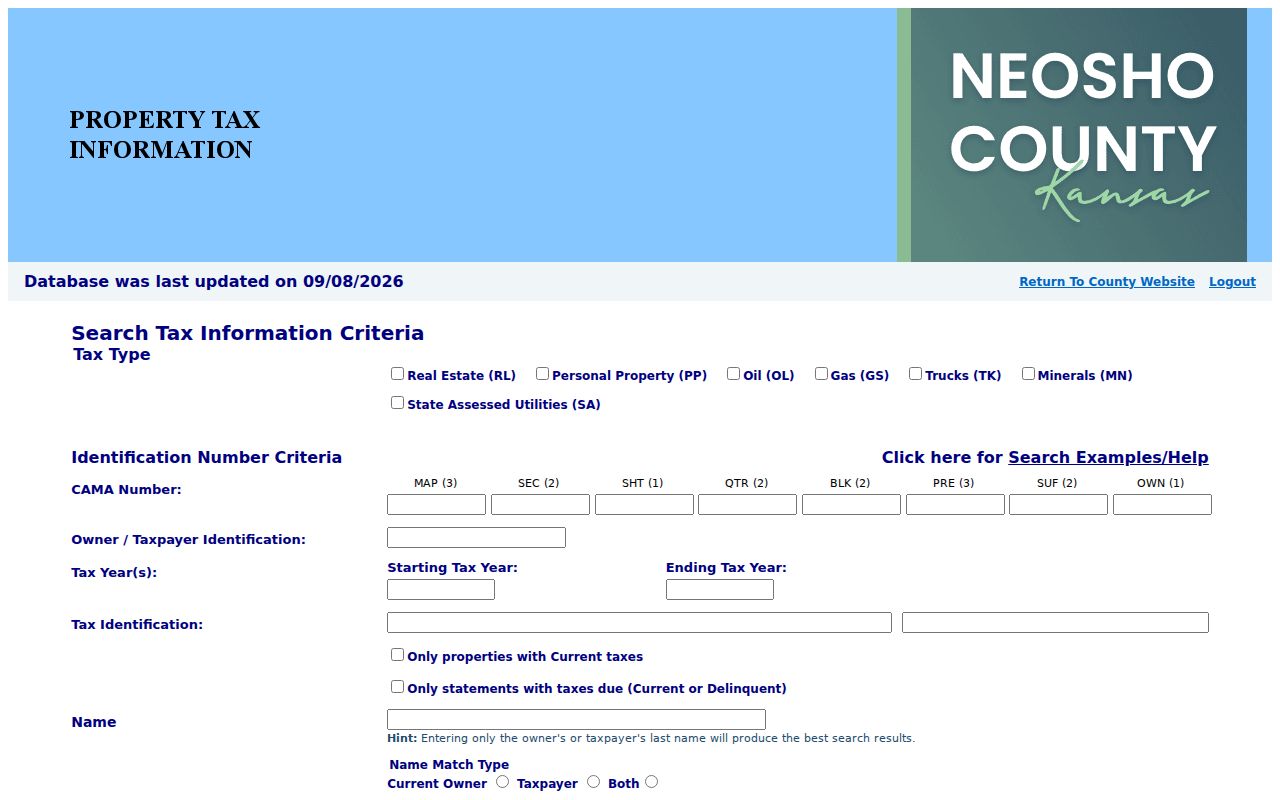
The official search page shows the entry screen for the tax owner lookup. Any result row should be described only from fields visible in the live system, and the database date should travel with the finding.
Check Seward County CAMA
The Seward County Public Parcel Search is the appraiser's CAMA gateway. CAMA stands for computer-assisted mass appraisal. The opening screen provides Sign In, Continue as Public User, and Request Access. Public access may stop at that gateway. The exact parcel-card owner label, history tabs, and export controls should not be assumed.
That gap matters. Claiming a specific "owner of record" field without seeing the card would be inaccurate. Treat the CAMA gateway as an assessor lead. Then record the wording from the live card. If access stops short, fall back on the tax module. You can also contact the County Appraiser at 620-626-3250.
Note: CAMA is an appraisal system. Even a named owner field is an administrative roll entry rather than a title opinion.
Separate Seward Owner Roles
An owner, a taxpayer, an occupant, and a mailing recipient can be four different parties. The site address identifies the land. The mailing address is where notices go. An occupant or family member may live on the property without holding title, and a tax service may pay the tax bill without owning anything. Compare the role label before associating any person with a parcel.
- Owner of record
- The name carried on an official administrative roll as the current owner.
- Grantee
- The party receiving the interest in a recorded conveyance.
- Title
- The legal rights in land, which cannot be guaranteed by a portal name alone.
- Situs address
- The physical property address, which can differ from the owner's mailing address.
Same-name results call for a parcel and legal-description match. Voter, license, corrections, or resident-agent data never replaces a deed. That distinction keeps a plausible name from turning into a false ownership claim.
Trace Seward Trusts and Entities
A trust, estate, or LLC may stand in for a person's name. The name appears on Seward County deed records instead. Search the exact recorded spelling plus reasonable variants. The county's recording-notification form itself encourages variants. These include initials, middle initials, full names, business names, and trust names. That local practice is a useful model for finding records. The notification service does not prove validity, though.
For an LLC or corporation, Kansas Secretary of State records can confirm the formal entity. They also show its current resident agent. Sole proprietorships, DBAs, assumed names, fictitious names, and trade names do not file there. They are absent from that business database. For an estate transfer, probate orders or a fiduciary deed may explain something. They may show why the grantee differs from an expected heir. Read the deed and the court record together.
Compare Seward Ownership Sources
The ownership sources answer distinct questions, so their dates and labels should travel with any conclusion you draw from them.
| Source | Owner Info It Gives | Access |
|---|---|---|
| Tax or appraisal roll | Administrative owner or taxpayer label | Public hosted portals |
| Register of Deeds | Grantee on the latest recorded conveyance | Subscription e-search or office |
| Secretary of State | Business entity and current resident agent | Free statewide search |
| GIS parcel viewer | Map identity and legal-location context | Free public viewer |
The CAMA and tax gateways carry a September 8, 2026 database date. That timestamp says nothing about the normal deed-to-roll lag. It also does not prove each parcel changed that day. A recorded deed with a later recording date may be more current than the roll.
Limit Seward County Owner Conclusions
An administrative owner result proves neither occupancy nor complete title. Nor does it prove the absence of unrecorded interests. A trust or LLC name can also hide the natural person a searcher expected. Kansas Safe at Home may replace a qualifying victim's address with a substitute legal address. Never try to reverse-engineer a confidential location from property, voter, court, or map records.
Not a title search. Use Seward County owner data for lawful property research and verify the latest deed. Never use it to stalk, harass, intimidate, or expose anyone.
Kansas open-records law does have edges. K.S.A. 45-230 limits how names and addresses taken from public records may be used. A civil penalty can reach $500 per violation. The county's GIS data request includes a certification that repeats those limits. So search a specific parcel for a documented reason. Skip the bulk list idea.
When an official portal stalls, go to the record keeper. Skip the commercial profile nobody has verified. The Register of Deeds takes questions in person, by phone, or by mail. The County Clerk publishes a KORA request form. A good request names the parcel, legal description, document type, and date range. It should also say whether you want inspection or a copy. Kansas agencies must answer as soon as possible. The deadline is no later than the end of the third business day. A timely response can still explain a delay or a lawful denial.
Some ownership changes never look like a normal sale. Probate orders, fiduciary deeds, tax-sale proceedings, and court judgments may all sit beside the recorded conveyance. A delinquent tax account is not a finished foreclosure. A tax-sale notice does not prove the bidder holds a deed. Keep each stage separate until the Register of Deeds record confirms the actual transfer.
Resolve Missing Seward Owner Records
A blank owner field or a gateway that will not open is a detour. It is not a dead end. Preserve what failed and move straight to the custodian. The County Appraiser maintains taxable and exempt real and personal property. The office can answer an appraisal-roll question. The Register of Deeds holds deeds, mortgages, easements, affidavits, plats, leases, and liens. The County Clerk receives the published KORA form. Picking the office by record type beats sending one broad request everywhere.
A focused ownership request should carry the parcel or CAMA number. Add the legal description and site address. Include the approximate recording date and the exact record wanted. Say whether inspection, an uncertified copy, or a certified copy is what you need. The Register office sits at 515 N Washington Ave, Suite 103, Liberal, and lists 620-626-3220. The Appraiser is in Suite 104 and lists 620-626-3250. Both offices serve property across Seward County, including Liberal, Kismet, and unincorporated land.
Keep a short source log. Record the search date, portal timestamp, and whether you used Current Owner or Taxpayer mode. Add the parcel identifier, legal description, deed recording date, and any field left unviewed. That log lets you explain why two county systems differed without calling either one wrong. It also gives office staff enough detail to reproduce the search.
Two possible owner names sometimes remain. Do not pick one by mailing city or surname alone. Match the complete land description and the newest instrument. Then state which source supplied the owner label. A precise unresolved result beats a confident guess every time.