
Inside Seward Property Tax Records
Two offices split the work in Seward County property records. The County Appraiser discovers, lists, and appraises taxable and exempt real and personal property. The Treasurer handles billing and payment. Neither office keeps the recorded title layer. That matters when a taxpayer name does not match the current owner of record, or a recent deed has not yet reached an administrative system.
| Field | What it shows | Official source |
|---|---|---|
| Appraised market value | The county's estimate as of the valuation date | County Appraiser |
| Assessed value | The taxable portion after the class rate is applied | Appraiser and valuation notice |
| Tax year and unit | The period and taxing-unit code tied to the account | Treasurer tax module |
| Current or delinquent status | Whether the search is limited to current accounts or statements with taxes due | Treasurer tax module |
| Owner or taxpayer match | A chosen name relationship, not conclusive proof of title | Treasurer tax module |
A market estimate, an assessed amount, and the tax due are related figures, not the same figure. A tax bill also cannot tell you what a willing buyer would pay. The separate Seward County value record sorts out those numbers without forcing them into a tax-bill estimate.
Seward Tax Search Choices
The public Seward County Tax Information Module goes well past a plain address box. Real estate, personal property, oil, gas, trucks, minerals, and state-assessed utilities all fall inside it. Pick Real Estate for a house, lot, commercial tract, or farm parcel. That choice covers land and buildings. Any field that does not help identify the account can stay blank.
| Search field | Format or choice | Best use |
|---|---|---|
| Owner or taxpayer name | Up to 30 characters; last name is recommended | Finding accounts tied to a known name |
| Name match | Current Owner, Taxpayer, or Both | Separating the owner label from the party billed |
| Street | Number up to 5; name up to 25 | Locating an urban parcel |
| Tax identifiers | Tax unit up to 3; parcel up to 20 | Returning to a known account |
| Rural criteria | Section, township, range, lease, or Quick Ref | Narrowing land without a stable street address |
| Subdivision | County dropdown with exact recorded labels | Finding lots by addition or phase |
The form displays Street Direction and ZIP Code labels. No visible input boxes sit beside them. Do not wait on those controls. Enter the street number and name, then narrow the results by subdivision or parcel. Subdivision spellings on screen carry abbreviations and truncations, so copy them exactly as shown.
View Seward Tax Criteria
The official tax-search screen lays out the county's filters: name, address, identifier, year, status, and legal-property fields.
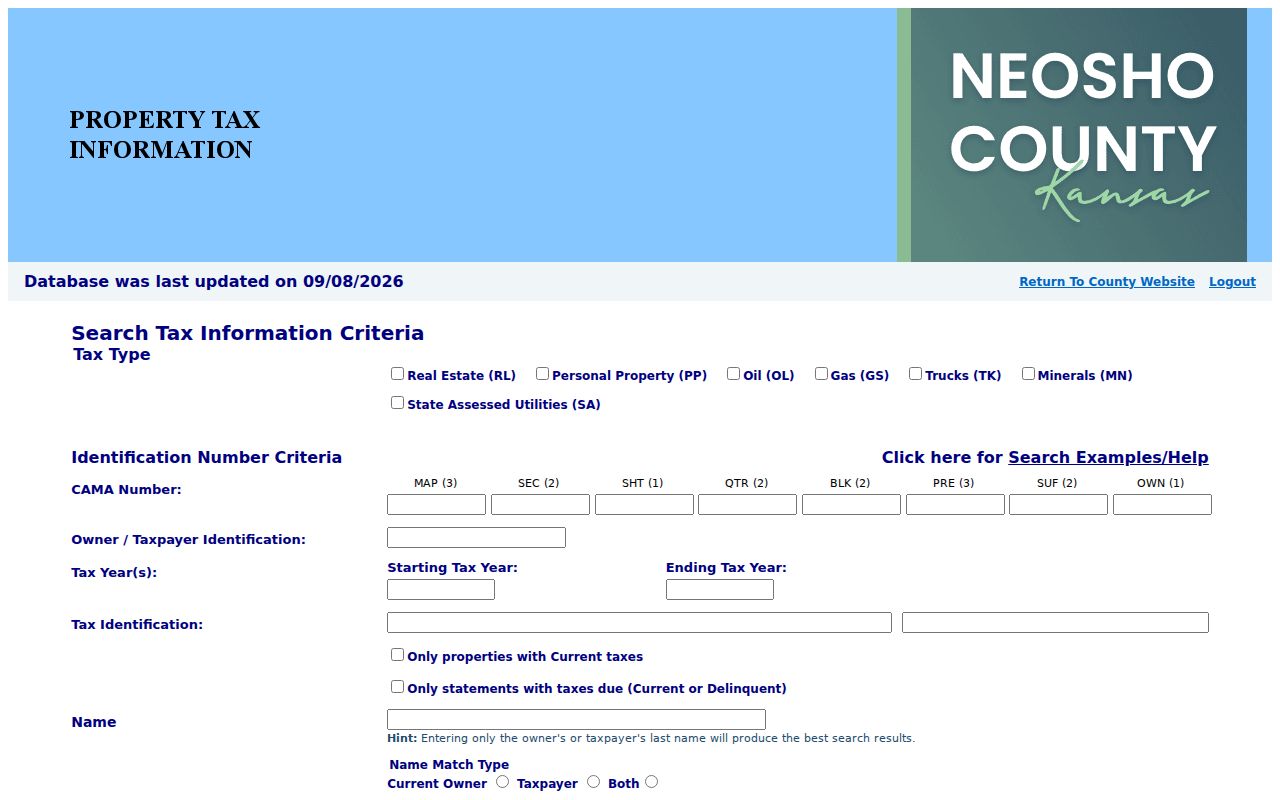
Read it as a map of the search fields. No result columns, print option, or payment detail should be assumed from it.
Trace a Seward Tax Bill
Begin with the narrowest fact known, and hold to one parcel identity from start to finish. The Treasurer page states its online search runs only February through May and November through December. Outside those windows, call the Treasurer at 620-626-3215 or request a printed receipt.
- Choose Real Estate and search the address, parcel number, or owner last name. Use Current Owner first for a present parcel question.
- Match the account to its legal description, subdivision, tax unit, or CAMA components. Do not rely on the name alone.
- Set the tax-year range and use the current-tax or taxes-due filter only when that limit answers the question.
- Compare the appraisal amount through the Public Parcel Search. Enter with Continue as Public User.
- For proof of a transfer, check the Register of Deeds. A tax account is not a title search.
- Assessed value
- The portion of appraised value to which the tax rate is applied.
- Mill levy
- A tax rate stated in mills; one mill is one dollar per thousand dollars of assessed value.
- Exemption
- A legal exclusion from tax that must meet its own eligibility and filing rules.
- Tax lien
- A claim arising from unpaid property tax, distinct from a deed transfer.
Seward Property Tax Dates
Seward County mails tax statements in November. Real-estate tax can be paid in full or in halves. The first half, or the full amount, comes due December 20. The second half falls due May 10. After that date, the whole unpaid balance plus interest is owed. Unpaid years from before must be settled before the current year. The county valuation page gives the official line on appraised value. It also covers assessed value and the mill levy.

These payment dates differ from appraisal dates. Property is valued as of January 1, and valuation notices are mailed March 1. Personal-property renditions are due March 15, while oil and gas renditions are due April 1. Keeping those calendars apart helps a reader contact the right office.
Note: The online tax search has limited seasonal windows, so preserve the parcel number and use the Treasurer's phone or receipt route when needed.
Contest a Seward Assessment
Valuation notices go out from the County Appraiser on March 1. A taxpayer then has 30 days from mailing to seek an equalization appeal. Start with the parcel card and the notice itself. Build the case from facts tied to that same property. Those include correct property class, land use, building details, condition, and comparable evidence. Remember that a payment dispute and a value appeal are different processes. The Seward County Appraiser sits at 515 N Washington Avenue, Suite 104, Liberal. The office is reachable at 620-626-3250. Ask which current form and submission method apply. A corrected value may change the bill. If so, confirm the new statement with the Treasurer rather than recalculating from the old notice.
Appeal window. The equalization appeal period is 30 days after the March 1 valuation notice is mailed, so act from the notice date.
Seward Exemption Filing
The Appraiser posts an annual Kansas Department of Revenue Claim for Exemption. The county sets the filing deadline at March 1. The office warns that failing to file can prompt it to question whether exempt status should continue. Kansas construes exemptions in favor of taxation. An old exempt label is never permanent proof. Homestead and property-tax relief programs deserve a check. Use the current county Taxes page and the state form named there. Eligibility can turn on facts outside the public tax record. The public account may show the effect of relief without proving why someone qualified.
Seward Delinquency and Tax Sale
Seward County property tax bills that go unpaid for three years can end in foreclosure. A public auction may follow. The county Tax Sale page walks through the process: published notices, certified letters, and a lawsuit. A redemption window comes before any sale. Redeeming the parcel takes more than the delinquent taxes. Court costs, attorney fees, and related expenses ride along with them. Opening bids at the auction can bundle the taxes and fees. Court costs and abstract expense ride along too.
Buyers should know the ground rules. Tax-sale property sells as-is, with no title guarantee. Purchaser restrictions apply, and a buyer cannot act until the deed is actually in hand. The county cautions that deed delivery may run 30 to 60 days. A delinquent account does not mean foreclosure is finished. An old sale notice is not a live inventory of parcels for auction.
Verify the stage. Match delinquency, lawsuit, sale, redemption, and deed records before treating any Seward County parcel as sold.
Seward Tax Record Freshness
The county posts a database-update timestamp on both the tax module and the CAMA gateway. A recent marker there signals an active system. It does not promise every parcel record changed that day. Seward County publishes no set lag between a deed recording and the matching update to the appraisal or tax roll. So treat the date as a general freshness cue.
Use the timestamp to judge how current the data is. Then cross-check the current owner of record. Check the parcel number, the appraisal notice, and the latest deed. That split keeps Seward County property tax records useful. It does not hand an administrative tax roll more authority than it deserves.