
Build Seward's Former Owner Timeline
A credible former-owner timeline rests on real deeds. Each row should stand for one transfer of ownership. It should not be a mortgage, lien, release, or a stray same-name filing. Seward County's e-search did not expose a sample chain for study. So treat the structure below as a worksheet. It is not a claim about any particular parcel in the county.
| Transfer Date | Grantor to Grantee | Deed Type | Book/Page |
|---|---|---|---|
| Newest recording | Prior owner to present grantee | Copy exact instrument label | Copy the source reference |
| Earlier recording | Earlier owner to prior owner | Confirm it conveyed title | Match land description |
| Next earlier recording | Repeat with the former grantee | Keep deed type | Preserve tab format |
| Unresolved gap | Do not guess either party | State record not viewed | Refer to office volume |
The newest deed names the first prior owner. Earlier deeds add the rest. Keep the recording date separate from the signing date. At every step, match the lot, block, addition, or section-township-range description to the same parcel.
Use Seward's G Book Prefix
The Seward County Register of Deeds passes along a local indexing tip. Put the letter `G` in front of the book tab when you search. Their sample reference reads `G768-025`. Leave off that prefix and a copied reference can fail in e-search. That looks like a broken chain but is not.
The eSearch gateway runs on subscription terms. The county posts a one-day pass at $25 and a one-month pass at $250. Printed copies run $0.25 each. Card processing through the service adds 2.9% plus $0.30. The office itself takes no credit cards. Phone, mail, in-person, and KORA requests still matter when the online volume is not enough.
The official Register page posts the office's recording details and fees for Seward County property records. It also posts search instructions.
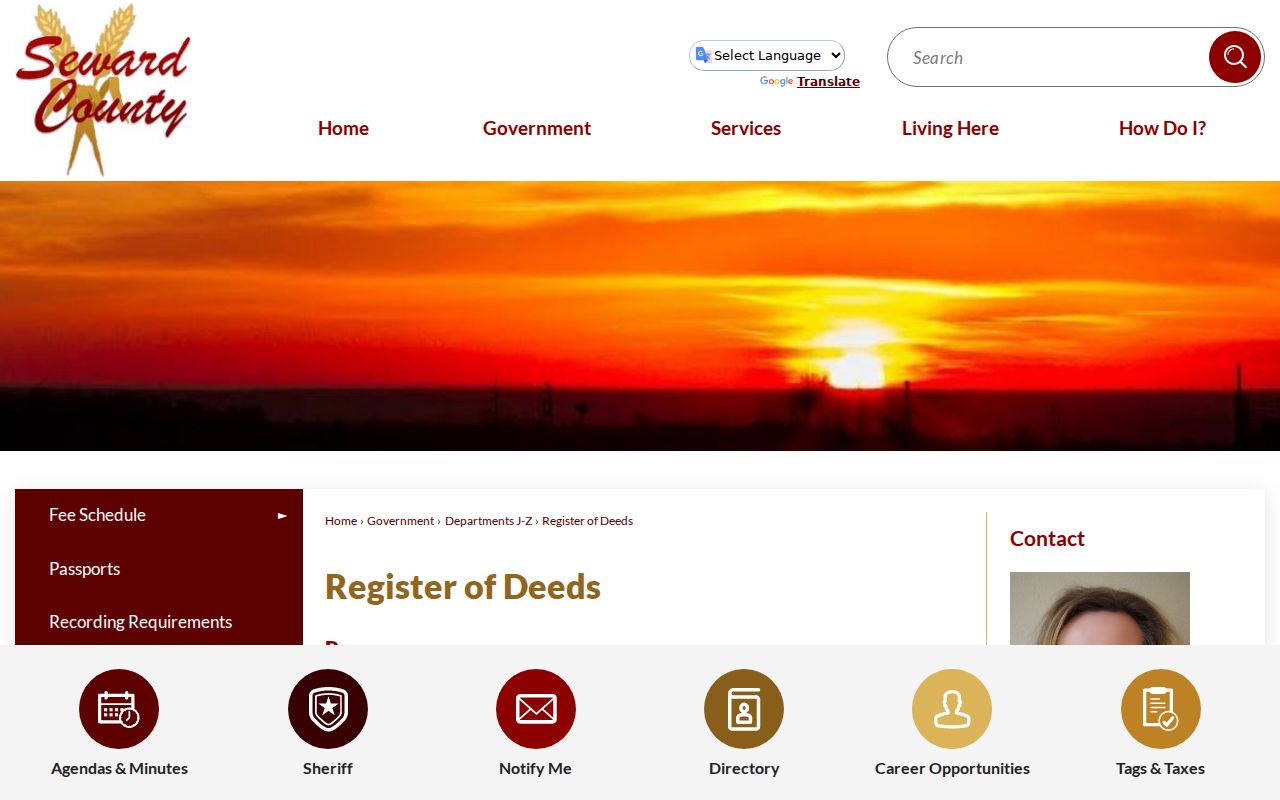
That page confirms the office and its gateway route. It states no earliest online deed year and shows no grantor-grantee sample result.
Match Seward Legal Descriptions
Names alone prove little in a chain. Inside a city, Seward County recording rules call for lot, block, addition, subdivision, or plat. Rural land needs section, township, and range instead. Compare the description across every transfer. Reject any deed tied to a different parcel, even one with matching party names.
Subdivision labels shift and branch into phases. The tax list includes ORIGINAL TOWN LIBERAL, ORIGINAL TOWN KISMET, KISMET CITY ANNEX, KISMET MILLER ADDN, and many named additions. Treat the county's exact abbreviation as a search lead. The deed and the recorded plat remain the real evidence. A ZIP code is not a legal boundary or title identifier.
Note: Under the county's published recording rules, a deed without a legal description may be entered but is not indexed to land.
Follow Seward Trust and Estate Names
A tidy personal-name sequence can break once land moves into a trust, an estate, or a business. Search each recorded party in both directions. Try initials, middle names, trustee phrasing, and the exact entity spelling. Seward County's property-recording notification form encourages many of these same variants.
Probate orders, executor deeds, administrator deeds, and affidavits often explain a transfer after death. Kansas vital records stay closed to the public, so a death certificate is no shortcut. When an LLC enters the chain, the Kansas business search confirms the formal entity. A resident agent never substitutes for the grantee.
Walk Seward's Deed Chain Backward
Start with the current parcel. Move back one verified conveyance at a time. Working forward from an old surname only makes sense when the legal description is already known.
- Confirm the present parcel and locate the newest deed with the current owner as grantee.
- Record the grantor, deed type, recording date, reference, and complete legal description.
- Search that grantor as an earlier grantee, then verify that the acquired land matches the same parcel.
- Repeat until the online index stops. Continue through office deed books, plats, and staff-assisted search rather than filling the gap.
- Grantor
- The party conveying the stated interest.
- Grantee
- The party receiving the stated interest.
- Chain of title
- The ordered sequence of instruments affecting ownership.
- Reverse index
- An index route organized from one side of the grantor-grantee relationship.
- Warranty or quitclaim
- Different deed forms whose legal effect must be read from the instrument.
A mortgage release changes or clears an encumbrance. It never names a former owner just because familiar names appear. Classify every document before it joins the timeline.
Extend Seward Ownership History
Seward County dates to 1873. But the online deed index does not promise full coverage back that far. When the index ends, contact the Register of Deeds at 515 N Washington Ave, Suite 103, Liberal. Or call 620-626-3220. Ask for a named book, tab, party, legal description, and date range. Office hours run weekdays from 8:00 a.m. to 5:00 p.m.
The Kansas Newspaper Database adds context on plats, additions, annexations, sheriff's sales, tax sales, and abstracts. KSHS microfilm helps too. KSHS also keeps Seward County school records from 1887 through 1986. Those may clarify old district geography. The Liberal Memorial Library offers public computers, local material, and interlibrary-loan help.
These sources are leads, not conveyances. Liberal Township annexation in 1948 and 1949 and Kismet's 2013 map explain boundary terms. Neither supplies a complete ownership chain for a parcel.
State Seward Chain Gaps Clearly
No official source states the earliest online year for Seward County's deed index. No public grantor-grantee sample or full deed-book sequence is viewable either. The honest timeline entry is simple. It reads "earliest online year not stated." From there, the office, mail, in-person, or KORA route carries the search. County existence since 1873 proves nothing about when the online run begins.
Record limit. Seward County's earliest online cutoff is not stated. Older former owners may require office deed books, plats, or archival context.
Document each unresolved jump. Name the last verified deed and the source still missing. Former-owner work supports house history, estate matters, and purchase diligence. It must never be used to stalk, harass, or expose a living person.
A KORA request can reach a specific nonexempt record when the usual portal falls short. Identify the parcel, party, instrument type, and date span. Say whether you want inspection or a copy. Kansas law permits actual-cost fees and does not convert confidential records into public ones. The agency must respond as soon as possible. It may take no longer than the end of the third business day. That response may simply give a delivery estimate or a legal basis for denial.
Keep newspaper and archive findings in a separate context column. A sheriff's-sale notice or abstract reference can explain why a name or place changed. So can a school-district boundary or annexation report. None of them replaces a deed. The strongest timeline cites each conveyance directly. It uses history sources only to interpret the gaps between verified transfers.
Classify Seward Land Instruments
The Register of Deeds files far more than deeds. Mortgages, easements, affidavits, plats, oil and gas leases, federal tax liens, UCC personal-property liens, military discharges, and auto-repair liens all sit in the Seward County deed records. Only some of these move an ownership interest. Read the instrument type and its operative language before adding anyone to the former-owner chain.
A mortgage names owner and lender but conveys nothing. A release can end a lien. An easement grants use of a strip, not title. A plat lays out land yet does not document each later lot transfer. An affidavit may clarify identity or estate facts without standing in as the purchase deed. These distinctions keep an encumbrance sequence from hardening into a false ownership timeline.
An unclear index label needs the image itself. Request it from the Register office. Compare the grantor, grantee, legal description, recording date, book or instrument reference, and signatures before deciding where the document belongs. The conveyance column and the context column each have their place. It is slower than hoarding same-name hits. It is also the only sound way to reconstruct prior owners of a Seward County parcel without inventing transfers that never happened.